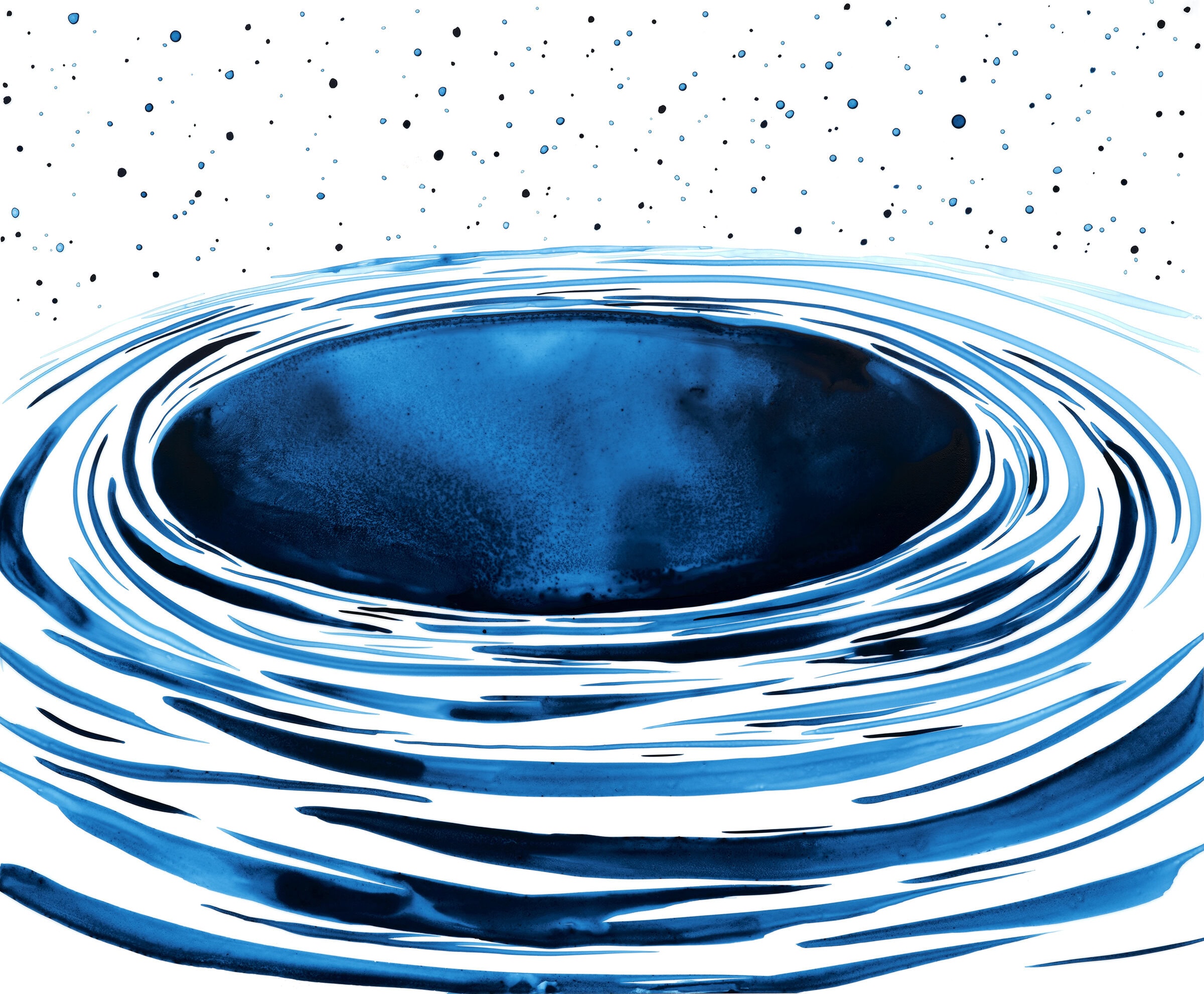
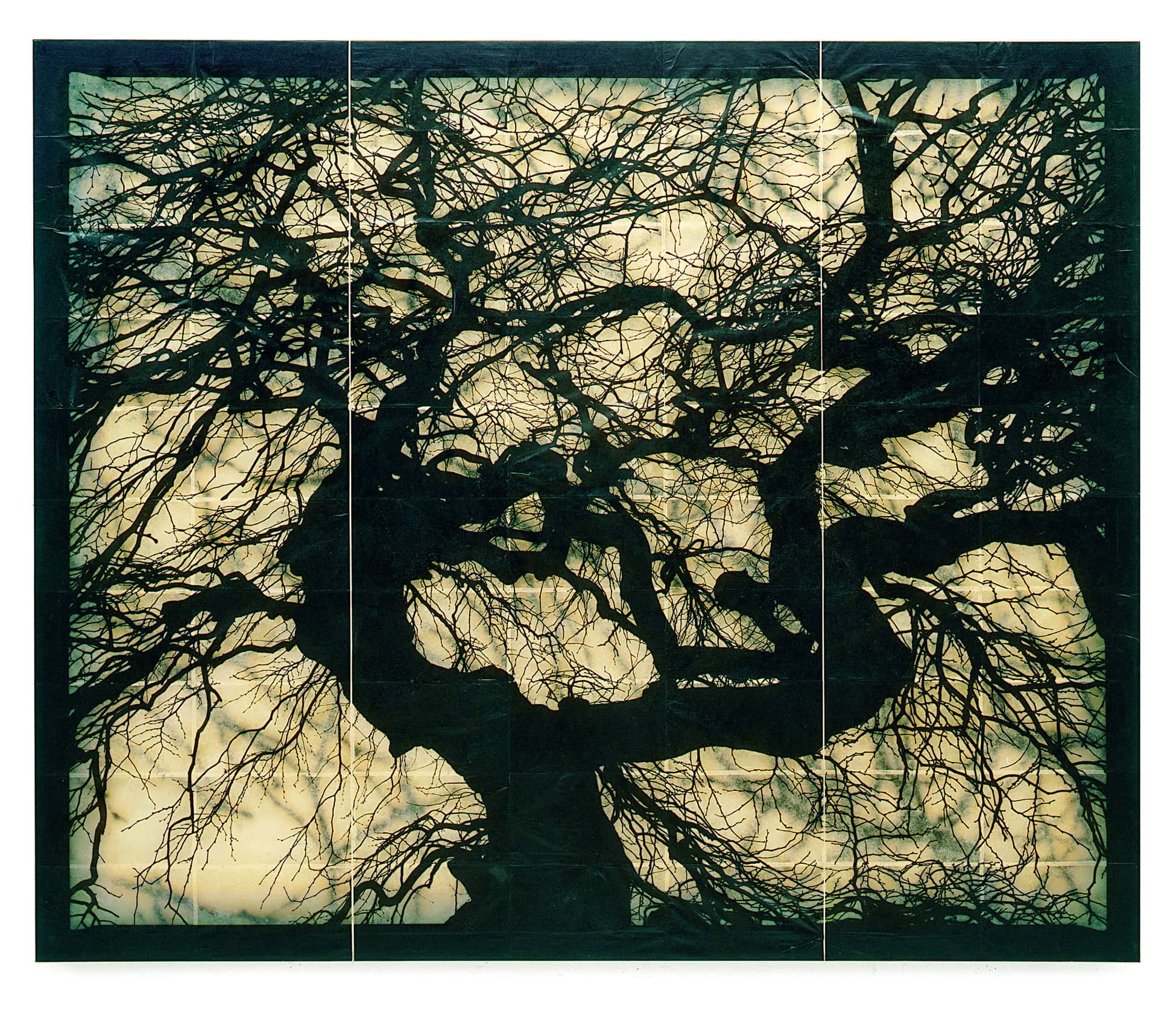
This exhibition brings together the work of artist Shanthi Chandrasekar and physicist-writer Michael Albrow in a shared exploration of how order and chaos in the universe are reflected across art, science, and human understanding. Through parallel and complementary practices, writing, drawing, and painting are placed in dialogue, offering multiple ways of perceiving the cosmos. The exhibition features 18 drawings and paintings by Chandrasekar, created between 2010 and 2025, paired with selected writings by Albrow.

Chandrasekar grew up in an Indian atomic energy research community shaped by both advanced science and ancient cultural traditions. Her work draws on Kolam, a South Indian practice of geometric rice-flour patterns made on thresholds, embodying impermanence, resilience, and cosmic order. Her process echoes Kolam’s evolution: structured grids and symmetries gradually shift, fracture, or dissolve, revealing hidden layers and new possibilities. These transformations resonate with principles in physics and cosmology, where symmetry and its breaking shape reality from the quantum to the cosmic scale.

Albrow’s writings reflect on symmetry as a foundation of physics and its breaking as the source of complexity, life, and an evolving universe. Together, the artists invite viewers to consider how pattern, balance, and rupture shape both the cosmos and human consciousness.

Biographies

Shanthi Chandrasekar is a Maryland-based multimedia and multidisciplinary artist whose practice is informed by academic training in physics and psychology, alongside study of the traditional Indian art forms of Kolam and Tanjore-style painting. While her work is rooted in Indian visual traditions, it is ultimately driven by a sustained inquiry into the mystery and majesty of the world around her, where scientific frameworks and spiritual contemplation converge.

Chandrasekar has exhibited widely and is the recipient of numerous honors, including Independent Artist Awards from the Maryland State Arts Council and Individual Artist Grants from the Arts and Humanities Council of Montgomery County. She has also been awarded Maryland Traditions Folklife Apprenticeships twice to teach Kolam, and has held prestigious appointments as a Culture Caucus member at the Kennedy Center (2022–2024) and as Artisan-in-Residence with the Smithsonian’s National Museum of Asian Art and the Center for Folklife and Cultural Heritage (2023).

Michael Albrow is a particle physicist whose career spans experimental research, public engagement, and interdisciplinary collaboration. He spent 18 years at CERN in Geneva, where he conducted foundational experiments in particle physics, later serving as a senior scientist at Rutherford Laboratory and a professor at Stockholm University. In 1991, Albrow joined Fermilab near Chicago, contributing to landmark discoveries including the top quark and the Higgs boson at CERN’s Large Hadron Collider. He has been a Scientist Emeritus at Fermilab since 2016, where he continues to develop research on long-lived particles and their possible interactions with dark matter.

Albrow is a Fellow of both the Institute of Physics (UK) and the American Physical Society, recognized for his commitment to outreach and education. He regularly gives public talks about physics and astronomy and collaborates with the KV 265 organization bringing science to concert audiences. He is the author of Space Times Matter: One Hundred Short Stories About the Universe and has collaborated with artist Shanthi Chandrasekar on five previous science-and-art exhibitions at institutions including American University, the Cosmos Club, the Kennedy Center, and the Athenaeum in Chicago.

Image: Shanthi Chandrasekar, Cosmic Structures, 2018, acrylic on canvas, 30 x 24 inches.

Delivery Method

  • In Person

Timing

  • Upcoming

Category

  • Exhibitions

Location

  • NAS Building
  • 2100 C St., N.W.
  • Washington, D.C.

Lia Halloran: Warped Side

February 3 - June 1, 2025
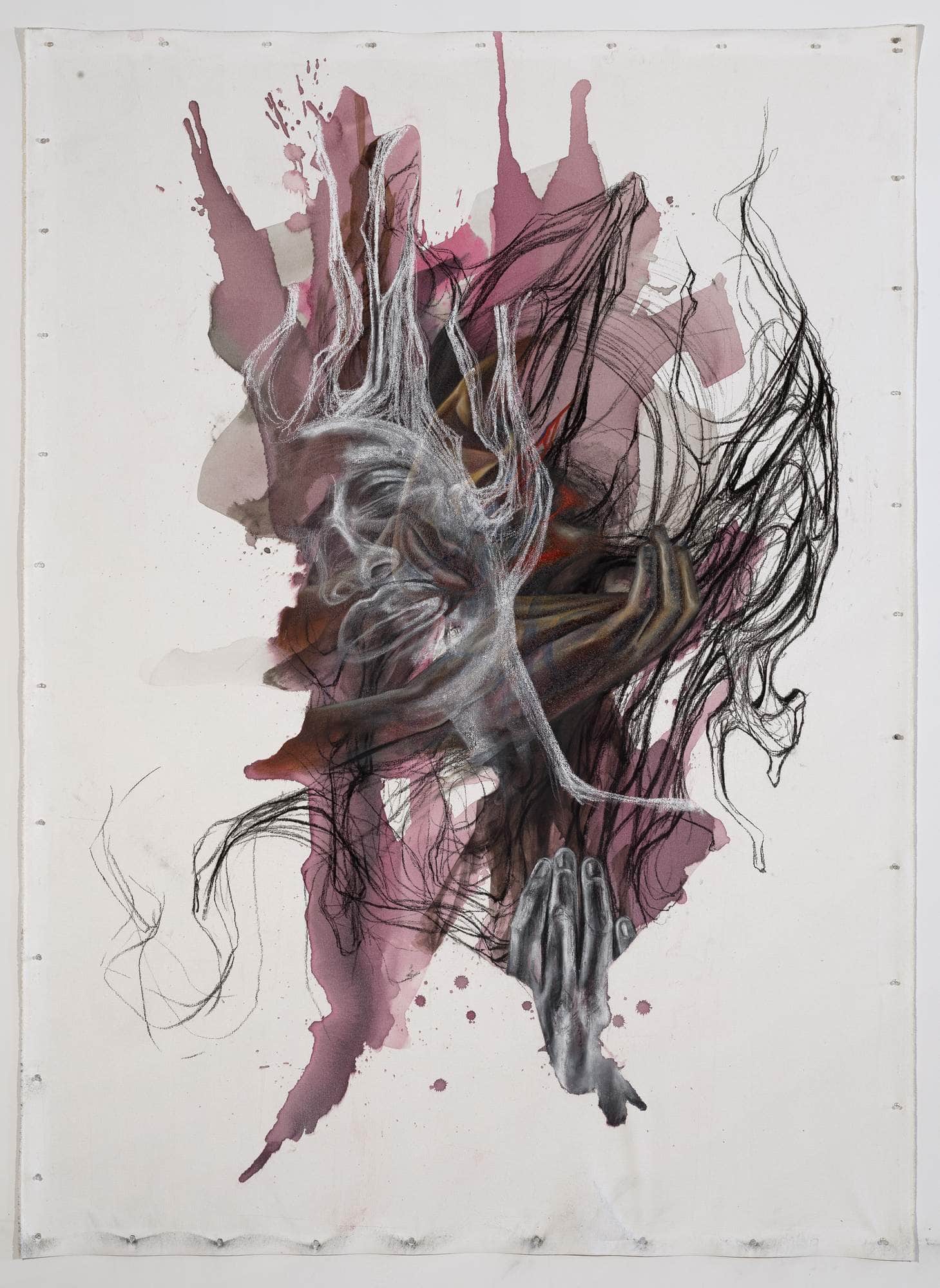
Circadian time signature

Imo Nse Imeh: Monuments to Our Skies

February 3 - July 1, 2025

Event Disclaimer

It is essential to the National Academy of Sciences mission of providing evidence-based advice that participants in any of our meetings or events avoid political or partisan statements or commentary and maintain a culture of mutual respect. The statements and presentations during our meetings or events are solely those of the individual participants and do not necessarily represent the views of other participants or the National Academy of Sciences, which is a non-partisan, tax exempt organization.